This full record display is using an old version of our collections database until it has been reconfigured to work with our new Collections Explorer.
In the meantime, if the record has been edited recently, the version you see here may contain out of date information. To be sure of finding the most up-to-date records please run the search again in Collections Explorer.
This is a temporary measure, in place only whilst the new system is being developed, and we apologise for any inconvenience. If you have any questions about the data in this record please contact the Documentation Office
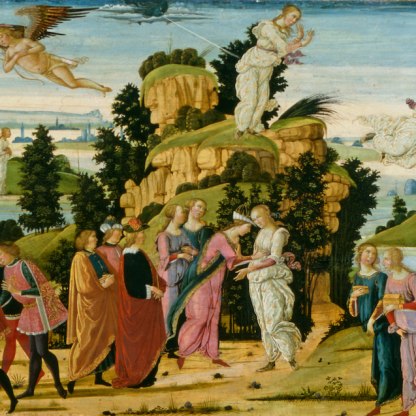
Mercury, Herse and Aglauros | |
Click on image(s) for larger view | |
Title/s | Mercury, Herse and Aglauros |
Maker/s | Maestro Giorgio Andreoli (workshop) |
Category |
tin-glazed earthenware |
Name |
plate |
School/Style | |
Description | Maiolica plate. Painted on the front in polychrome, with Mercury, Herse and Aglauros. Plate. Buff earthenware, tin-glazed overall; the reverse pale beige. Painted in blue, green, yellow, and orange; red and shades of yellow-gold lustre. Shape 50. Circular with slightly sloping rim and shallow depression in the middle, standing on a footring. Mercury, Herse and Aglauros. Mercury stands holding his rod in his left hand, his right extended towards Aglauros who stands in the doorway of the palace. On the left, Herse sits indoors beside a window, resting her head on her right hand. The arch of the window springs from a column decorated with scrolling foliage. On the wall above is a shield charged with the arms party per pale undy azure and or (shown orange) a mullet and a crescent counterchanged. In the foreground there are four pebbles on the path, and in the background to right, rocks and a large expanse of sky. The back is marked in the middle in thick orange-yellow lustre, `1522/.M o .o G' (both o raised). The base is encircled by a wide blue band and a narrow lustre band repeated in reverse order next to the rim. Between these are four crossed lozenges alternating with two spirals between curved strokes and two groups of spots between curved strokes. |
Production Notes | The figures of Mercury and Aglauros were derived from a woodcut in Ovidio metamorphoseos vulgare, Venice, 1497, p. XVIIIv, or in one of the Latin or Italian editions published in 1505, 1508, 1509, 1513, and 1517. |
Production Place | Gubbio (workshop) (place) Umbria (workshop) (region) Italy (workshop) (country) |
Technique Description | Buff earthenware, tin-glazed overall; the reverse pale beige. Painted in blue, green, yellow, and orange; red and shades of yellow-gold lustre. |
Dimensions |
height: (whole): 2.7
cm |
Period | 16th century |
Date | 1522 |
Provenance | bequeathed: Clarke, Louis Colville Gray 1960 (Filtered for: Applied Arts collection) Henry T. Hope, Deepdene, Surrey; by descent to the 6th and 7th Dukes of Newcastle-under-Lyme; Christie's, 7 July 1921, Catalogue of fine old English silver-gilt plate, Limoges enamels, old Italian majolica and porcelain, the property of his grace the Duke of Newcastle, and removed from Clumber, Worksop, lot 120; George A. Lockett; Christie's, 11 June 1942, The choice collection of objects of art and furniture formed by the late George A. Lockett Esq., lot 217; Alfred Spero (£556); from 1943, L.C.G. Clarke.L.C.G. Clarke Bequest |
Inscriptions/Marks |
|
Documentation |
|
Other Notes | The subject was taken from Ovid's Metamorphoses, II, 708-832. The scene could illustrate Mercury's first or second visit to Cecrops' palace to see Herse with whom he had fallen in love. On the first occasion he was met by her sister Aglaurus who declined to lead him to Herse, and demanded gold for her compliance before sending him away. On his return, Aglaurus, who had become extremely envious of Herse's good fortune in attracting a lover, barred the way to her room. Thereupon Mercury exercised his supernatural power to open the door and transformed Aglaurus into stone. |
Accession Number | C.79-1961 (Applied Arts) |
Related Image/s